

Bader began by studying texts about the era and poring over the New York Public Library’s picture collection. “I like to ingest as much imagery and text as possible and to sort of catalog it and be very free associative with what I choose,” he explains. The work of artist William Hogarth became a frequent reference point, his paintings and engravings of 18th-century England informing the earthy color palette and squalid lifestyle of Manchester’s pre-industrial working class—the “messiness of crawling out of medieval time into modernity,” as Bader puts it.
Historic cutaways of English boarding houses and other artworks of the day served as further source material, though Bader also looked to less straightforward places for inspiration. “For example, my initial pitch book had Charlie Bucket’s family’s house [from Willy Wonka and the Chocolate Factory] for the Lee family home, just because I knew that there was something about four people sitting in a shared bed in a very densely decorated space.” And while we don’t literally see two sets of grandparents sleeping toe-to-toe in the final film, that reference can be felt in the cramped, candlelit living quarters that we see on screen.
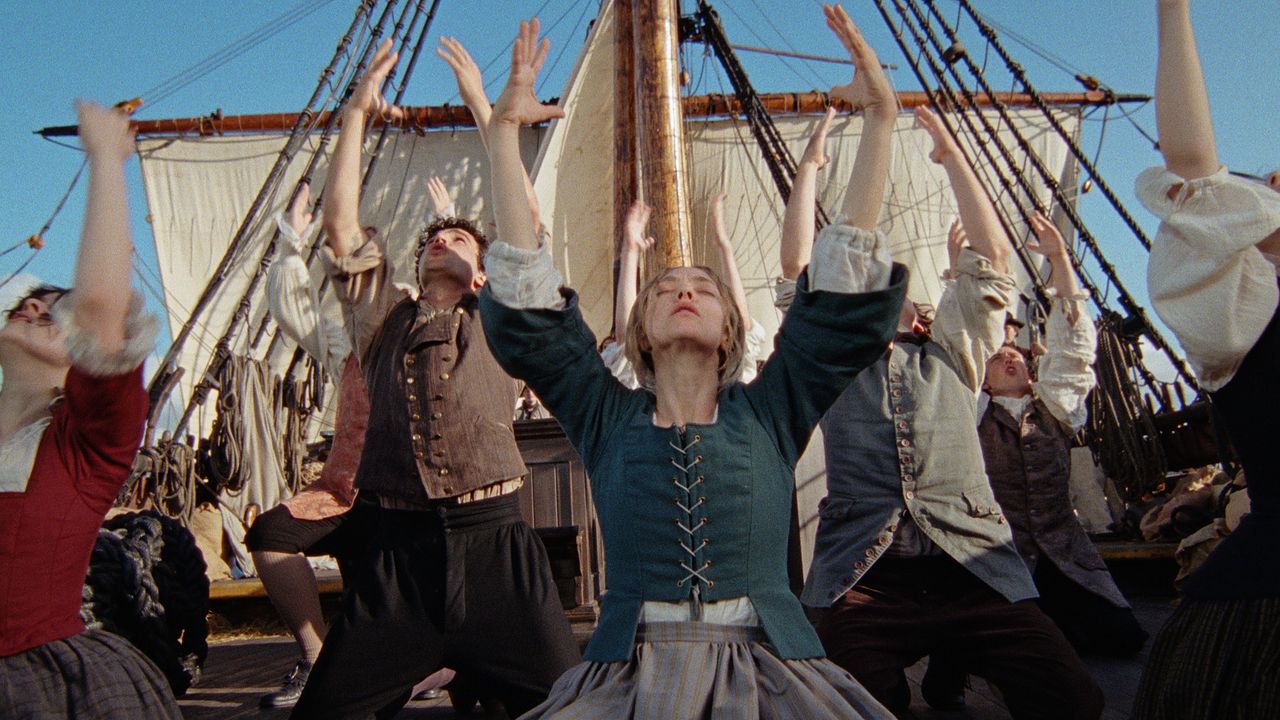
Like The Brutalist, The Testament of Ann Lee was primarily filmed in Budapest, Hungary, over just 34 days. Studio backlots hosted the streets of Manchester, an early-19th-century fort served double duty as the onscreen infirmary and prison, while a smattering of other locations were found in the area, including a goldmine of a property an hour outside of the city that provided space for the Shaker settlements, the textile mill where Lee works as a child, and several character homes. For the ship that takes Lee and her followers to America, the production filmed on Sweden’s Götheborg, a functioning replica of an 18th-century ship, which they used in concert with a smaller, seaworthy boat, and built sets to represent the spaces below deck. A small amount of footage was also shot on location at the Hancock Shaker Village in Massachusetts.