
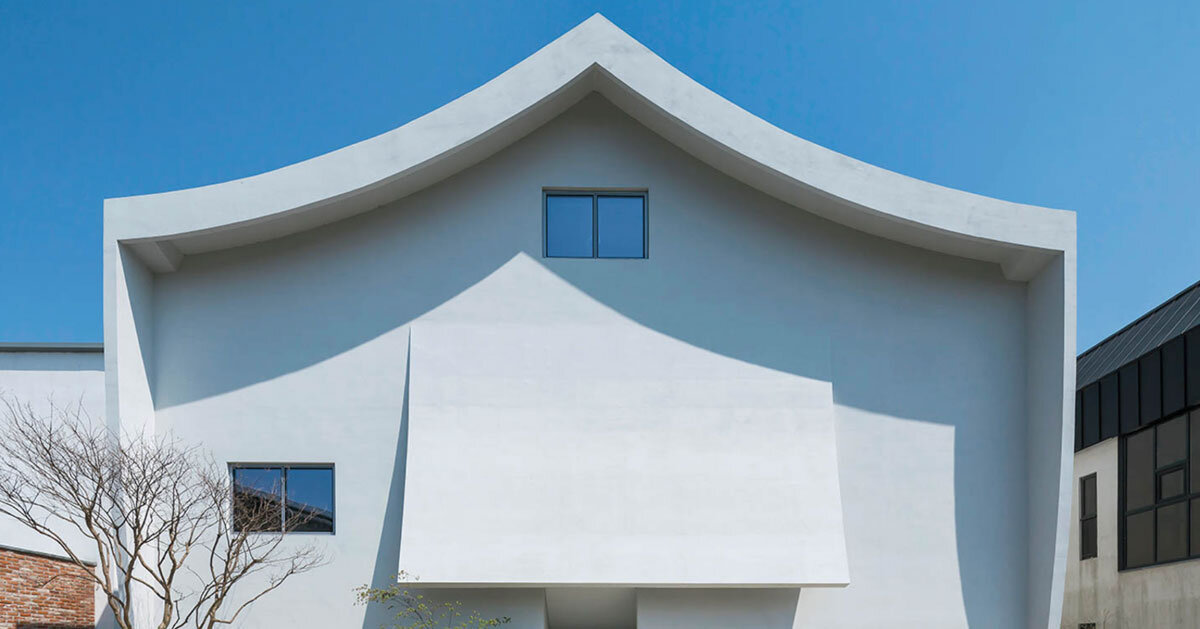

Traditional Korean Spatial Principles inform HO-UN residence
HO-UN is a private lakeside residence designed by Seoul-based practice IROJE KHM Architects in Jeonju, South Korea. Located along a lakeside park within a newly developed residential district, the house occupies a prominent site in a city known for its strong association with traditional Korean history and culture. Positioned at the center of the neighborhood, the site benefits from direct visual access to the lake while remaining embedded in an urban context.
The project was conceived as a residential retreat situated between city and nature. The architectural strategy responds to this condition by creating a spatial environment that balances inward-focused living with controlled visual connections to the surrounding landscape. The house is designed to function as both a place of privacy and a structure that maintains dialogue with its immediate context. IROJE KHM Architects reference elements of traditional Korean architecture and reinterpret them through a contemporary architectural language. Rather than reproducing historical forms, the project translates spatial principles and formal characteristics into a modern residential typology. This approach reflects the cultural context of Jeonju while addressing current residential needs.
all images by Sergio Pirrone
IROJE KHM Architects designs Courtyard-Centered Living space
The primary architectural concept is the ‘Gate of Life,’ derived from the traditional Korean element known as Numaru. This feature functions as a framed opening that mediates between interior and exterior conditions. Acting simultaneously as a boundary, a screen, and a visual device, the gate frames views toward the lake and city while regulating exposure and privacy. It operates as a spatial threshold that connects the inward-oriented courtyard with the broader landscape beyond. Outdoor space is organized around a central courtyard based on the traditional Madang. Enclosed on three sides, the courtyard functions as an intermediate space between interior rooms and the surrounding environment. This open void introduces light, air, and visual relief into the house, serving as a spatial buffer and a focal point within the overall layout.
The building’s roof form references the sense of upward movement commonly found in traditional Korean architecture. A simplified, curved A-type eave roof is reinterpreted in a contemporary manner, contributing to the building’s overall silhouette and reinforcing its cultural lineage through form rather than ornament. For the name of the house, studio IROJE KHM Architects selects HO-UN, meaning ‘cloud over the lake,’ which is reflected in the interior spatial arrangement. A family room is positioned above the living room and articulated as a cloud-like volume, creating a vertical spatial relationship between communal areas and reinforcing the project’s connection to its lakeside setting.
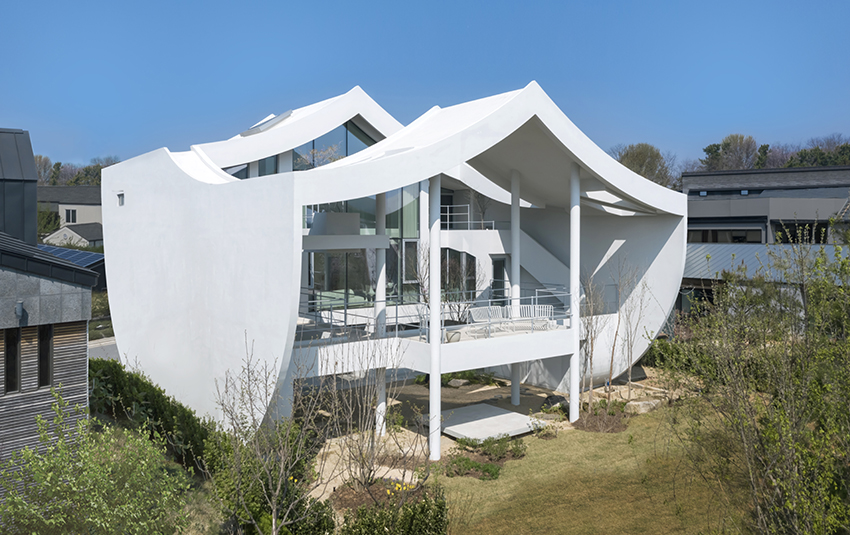
HO-UN is a private lakeside residence designed by IROJE KHM Architects in Jeonju, South Korea
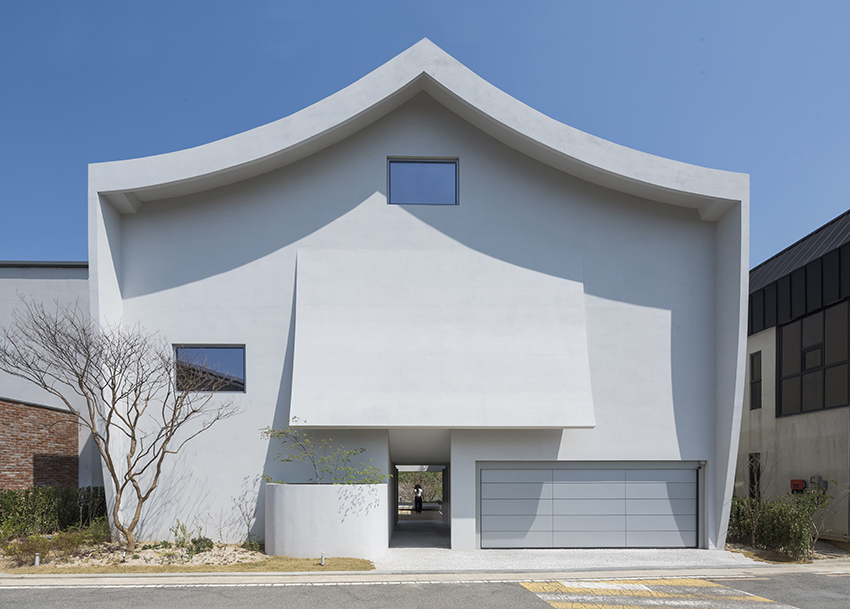
the roof form references upward movement found in traditional Korean architecture